
Returning to Yourself
What's Your MO? And Is It Still Working for You?
13 November 2026 · Stef
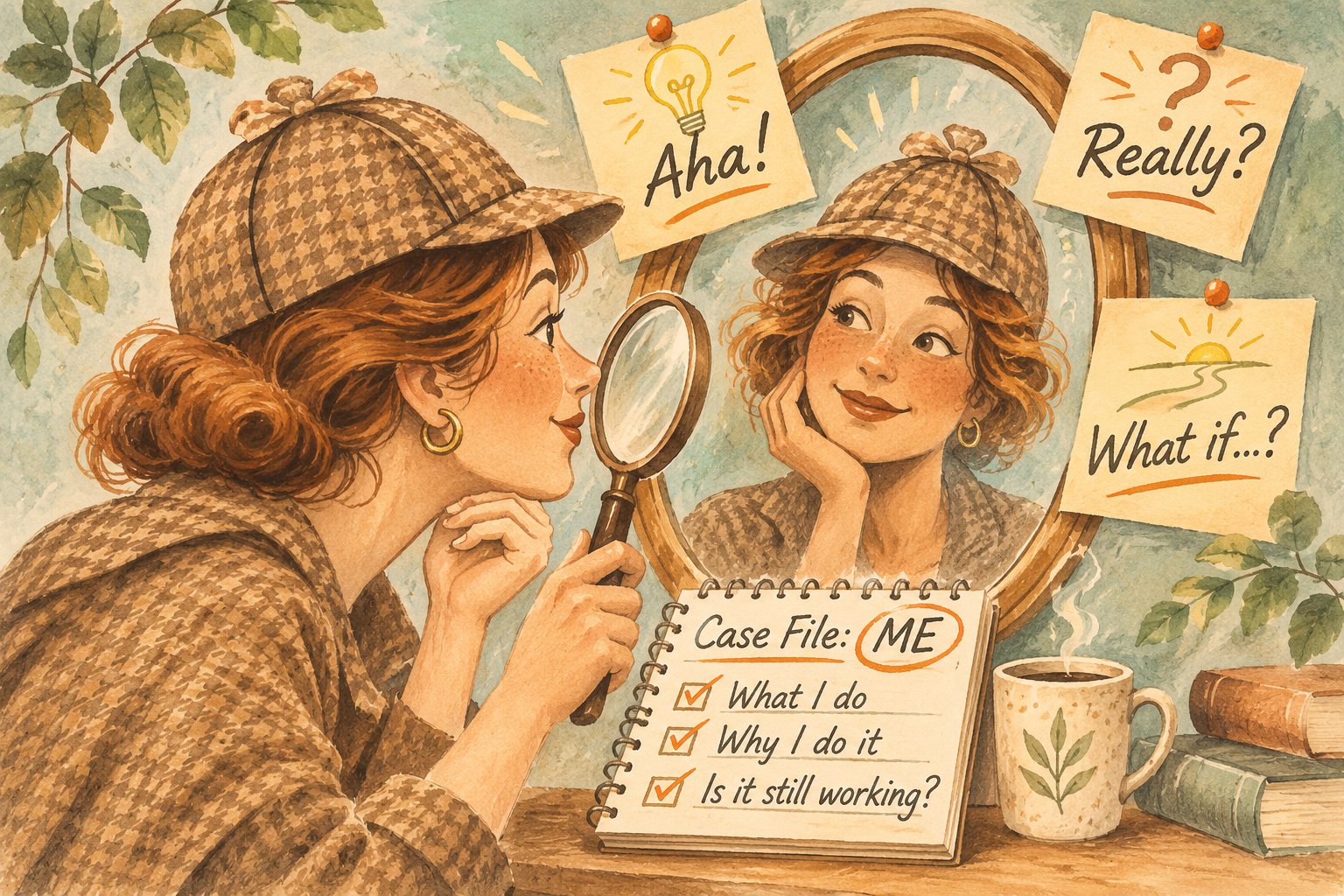
Have you ever stopped to think about your MO? Your modus operandi, your usual way of operating.
It's a phrase we often associate with detectives and criminals, but I've been thinking about how we all have our own MO. Probably several, actually. Those familiar ways we respond to situations, navigate relationships, deal with difficult feelings and try to get our needs met. The things we do almost without thinking.
For a long time, one of mine was making other people happy.
I was the easygoing one. The one who could take a joke, didn't make a fuss and generally went along with things. And I quite liked being known as easygoing. I took it as a compliment.
But I've come to realise that sometimes, in trying to be easygoing for everybody else, I wasn't being particularly honest about what I wanted or needed. I'd agree with something I didn't entirely agree with. Say yes when I wanted to say no. Laugh something off when actually it had bothered me.
And if I sensed that somebody wasn't happy, I'd notice it almost immediately. A slight change in their tone, a shift in the atmosphere, something I couldn't necessarily put my finger on. Of course, that didn't mean something was actually wrong. But I could feel myself responding to it anyway. Perhaps I'd make a joke to lighten the mood, change the subject or try to smooth things over.
And if I thought I'd upset somebody, I could spend hours replaying the conversation in my head. Sometimes I'd even have imaginary conversations, saying all the things I hadn't felt comfortable saying at the time.
That's been one of my familiar ways of operating. Yours might look completely different.
Perhaps you're someone who needs to feel in control. Maybe you find it difficult to ask for help, or you keep yourself constantly busy. Perhaps you withdraw when things become uncomfortable, or feel the need to fix everything for everyone else.
We all develop our own ways of navigating life, often without giving much thought to where they've come from or why we do them. And that's what I've become curious about.
Why do we operate the way we do?
Something I've come to understand through my own personal work, and the work I now do as a therapist, is that many of our familiar behaviours are ways we've learned to navigate the world. We develop them through our experiences, our relationships and the meanings we make of what happens to us. And often, they serve a purpose.
Looking back, I can see how important it became for me to keep the peace and feel accepted. Being agreeable, being good, not disappointing people. These were ways of maintaining connection with the people who mattered to me. And connection was incredibly important. So perhaps it makes sense that I became good at noticing how other people were feeling and adapting myself accordingly.
But here's something I find particularly interesting.
Two people can behave in exactly the same way, but for completely different reasons.
Someone might work incredibly hard because they genuinely love what they do. Someone else might feel they have to achieve in order to be good enough. One person might love their independence, while another might have learned that relying on other people feels risky. And someone might genuinely be easygoing, while another has learned that disagreeing with people feels uncomfortable.
So it's not necessarily about the behaviour itself. It's about becoming curious about what's underneath it. What might that behaviour be doing for us? What might we be trying to avoid, protect or achieve? And perhaps most importantly, is it still helping us in the way it once did?
Perhaps your MO needs an update
I've been thinking about how our adaptations have a lifespan. The ways we learned to operate may have made perfect sense at one point in our lives. They might have helped us feel safe, accepted, loved or in control.
But life changes. We grow. Our circumstances become different. And yet sometimes we continue operating in exactly the same way, almost as though our internal operating system is still running an old version. And perhaps that old version is no longer giving us what we need.
For me, trying to keep everybody happy took up an enormous amount of energy. Constantly noticing how other people were feeling, wondering whether I'd upset somebody, trying to avoid conflict or disappointment.
And the irony is that, in trying so hard to maintain connection with other people, I wasn't always allowing them to know the real me. Because how could they know what I wanted, what I thought or what mattered to me if I wasn't expressing those things?
And sometimes I didn't even know myself. I'd become so accustomed to considering what everybody else wanted that I hadn't always stopped to ask what I wanted.
So what happens when you start operating differently?
I still notice when somebody's mood changes. I can still feel uncomfortable if I think I've disappointed somebody or made a mistake. That hasn't magically disappeared.
But what has changed is how I respond.
I'm learning that somebody else can be unhappy without it being my responsibility to make them happy. That I can say no to something, even when I know the other person might be disappointed. That I can have a different opinion without needing to defend it or persuade somebody else to agree.
And that sometimes the most helpful thing I can do is allow another person to have their feelings, without immediately trying to change them.
That includes my children. Because sadness, disappointment and frustration are part of being human. And while there are times when our children genuinely need our help, there are also times when they need us to be alongside them rather than rush to make everything better.
It's something I'm still learning.
But there's something rather lovely about not feeling quite so responsible for everybody else's happiness. It creates space. Space to breathe. Space to notice how I'm feeling. Space to discover what I actually want, what I need and what makes me happy.
And I think that's been one of the biggest gifts of doing this work. Not becoming a completely different person, but having more freedom to be myself.
What's your MO?
Perhaps you've never really thought about it before. Maybe there's something you do automatically that you've always considered part of your personality. Perhaps it's something you're proud of, something other people have always admired about you. And it may well be a genuine strength.
But I wonder whether there are times when that same way of operating makes life harder than it needs to be. Does it leave you exhausted, anxious, frustrated or disconnected from yourself or the people around you? Does it sometimes stop you expressing what you really think, asking for what you need or allowing other people to support you?
Or perhaps it's simply something you've been doing for so long that you've never considered another way.
You don't have to judge it or immediately try to change it. Maybe just start by noticing. What do I tend to do when things feel uncomfortable? What might I be trying to avoid, protect or achieve? And is this way of operating still serving me?
Because perhaps you don't need an entirely new MO.
Perhaps yours just needs an update.
If this has got you thinking about your own MO, or perhaps you're curious to understand a little more about why you respond to certain things the way you do, you're always welcome to get in touch. It's the kind of thing we love exploring with people at Quantum Goddess Healing, and sometimes having someone alongside you can make all the difference.
With love,
Stef x
Quantum Goddess Healing
self-awareness · personal-growth · behaviour-patterns · self-discovery · people-pleasing